Methodology

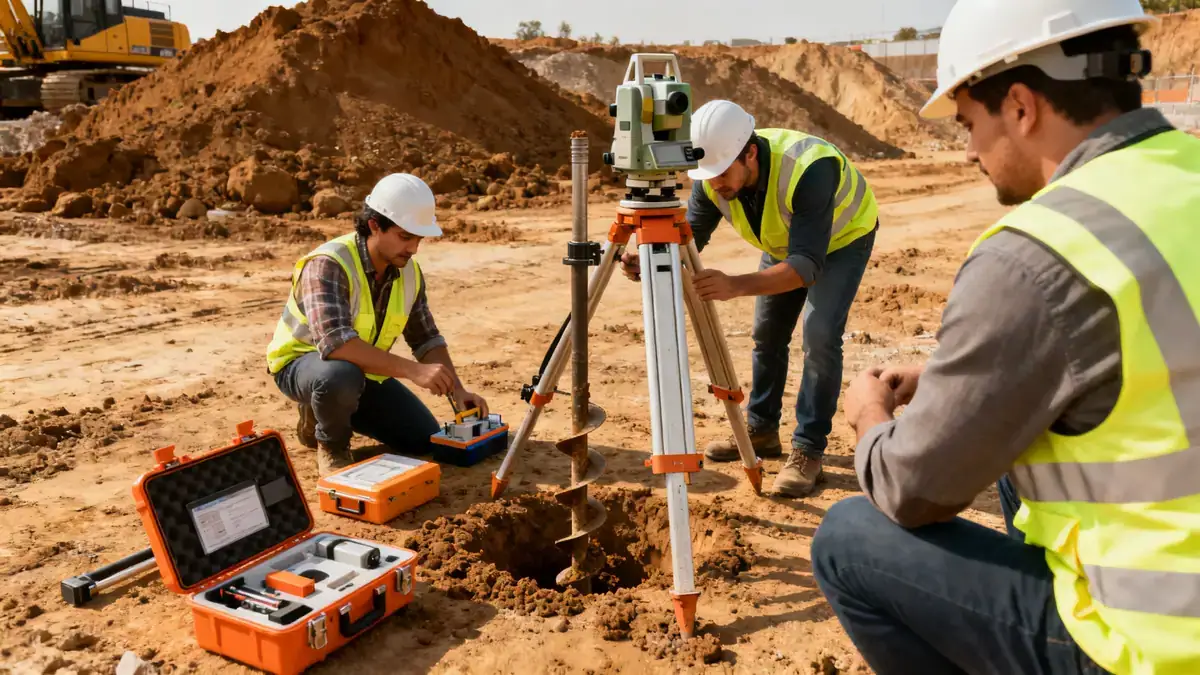
Our methodology integrates field exploration, laboratory testing, and advanced numerical modeling to characterize subsurface conditions accurately. We conduct Standard Penetration Tests (SPT) in accordance with ASTM D1586 to obtain soil resistance parameters, supplemented by undisturbed sampling for advanced laboratory analyses. Our SPT Boring program provides continuous soil profiles and groundwater observations, forming the basis for foundation design and slope stability assessments. All data are synthesized into actionable recommendations, ensuring compliance with local codes and project-specific performance criteria.
Reference Technical Parameters
| Parameter | Reference Value |
|---|---|
| SPT Blow Count (N-value) | 4–50 blows/ft |
| Unconfined Compressive Strength (rock) | 1,000–25,000 psi |
| Soil Plasticity Index (PI) | 5–40 |
| Groundwater Depth | 2–50 ft below grade |
| Slope Stability Factor of Safety | 1.3–1.5 (static) |
Local Considerations — USA
The United States presents diverse geotechnical challenges, from active seismic zones along the Pacific Coast to soft clays in the Gulf region and expansive soils in the interior. Our team is experienced in adapting design approaches to local conditions, including liquefaction assessments in seismic areas and deep foundation solutions in compressible strata. For instance, projects in regions like Akron often involve glacial till and shale bedrock, requiring careful evaluation of bearing capacity and excavation stability.
Request a Quote
Our team reviews your project and issues an initial report at no cost.
Or write us directly at [email protected]
Applicable Standards
- ASTM D1586 (Standard Penetration Test)
- ASCE 7 (Minimum Design Loads for Buildings and Other Structures)
- International Building Code (IBC) – Chapter 18 (Soils and Foundations)
- AASHTO M 145 (Classification of Soils for Highway Construction)
Frequently Asked Questions
What is the typical scope of a geotechnical investigation for a commercial building?
A standard investigation includes 3–5 borings to depths of 30–50 ft, SPT sampling, laboratory testing (index properties, strength, consolidation), and a report with foundation recommendations and allowable bearing capacities.
How are seismic site classifications determined?
Seismic site classification per ASCE 7 is based on average shear wave velocity (Vs30) or SPT N-values. Our team performs geophysical surveys or uses correlated N-values to classify sites as A through F, influencing design spectral accelerations.
What is the difference between a slope stability analysis and a retaining wall design?
Slope stability evaluates the factor of safety of natural or cut slopes against sliding, using methods like Bishop's Simplified. Retaining wall design calculates lateral earth pressures and structural resistance to prevent wall failure, often requiring drainage and reinforcement.