Methodology
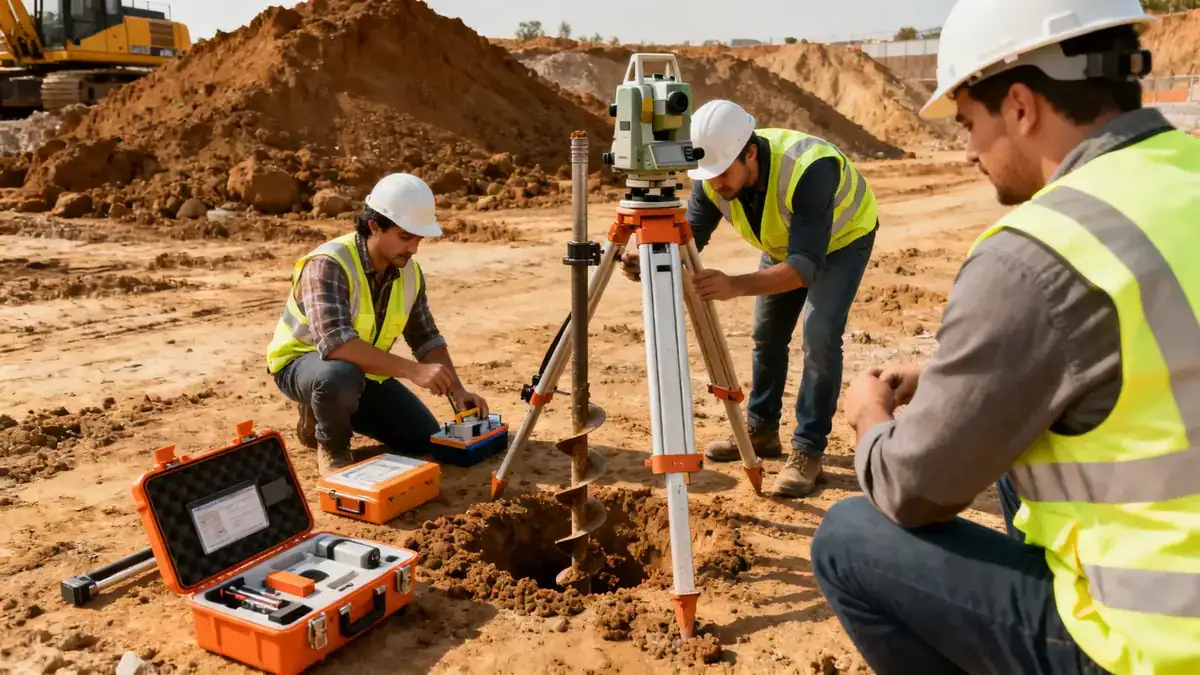
Our methodology for Tallahassee projects begins with a thorough review of existing geological data and site history. We then conduct field investigations, including spt boring to retrieve disturbed and undisturbed samples, following ASTM D1586 standards. Laboratory testing classifies soil properties such as grain size, plasticity, and strength. For seismic assessments, we evaluate site class per ASCE 7, using measured shear wave velocities when necessary. Groundwater monitoring and bedrock depth determination are integrated into our analysis. This systematic approach ensures that foundation designs, slope stability evaluations, and retaining wall designs are based on accurate, site-specific data.
Reference Technical Parameters
| Parameter | Reference Value |
|---|---|
| Predominant soil type | Sand and sandy clay over limestone |
| Maximum seismic acceleration (PGA) | 0.15g (ASCE 7-16) |
| Typical groundwater level | 3–8 ft below ground surface |
| Bedrock depth | 10–50 ft (limestone) |
| Typical N60 range | 10–40 blows/ft (SPT) |
Local Considerations — Tallahassee
Tallahassee's geology is dominated by the Woodville Karst Plain, characterized by sandy soils underlain by limestone with potential sinkhole development. The water table is shallow, often within 3–8 ft, requiring dewatering considerations for excavations. Seismic design follows ASCE 7 with a PGA of 0.15g, but local site amplification due to soft soils can increase demands. Older neighborhoods near downtown may have undocumented fills, while newer developments in the northeast encounter more competent sands. Typical challenges include variable bedrock depth and expansive clay lenses. For broader regional context, our team also provides geotechnical engineering in Atlanta, where Piedmont geology presents different conditions.
Request a Quote
Our team reviews your project and issues an initial report at no cost.
Or write us directly at [email protected]
Services in Tallahassee
Applicable Standards
- ASTM D1586 (Standard Test Method for Standard Penetration Test (SPT) and Split-Barrel Sampling of Soils)
- ASCE 7-16 (Minimum Design Loads and Associated Criteria for Buildings and Other Structures)
- Florida Building Code (FBC, 2023 Edition)
- IBC 2021 (International Building Code, adopted locally)
Frequently Asked Questions
What are the typical soil types encountered in Tallahassee?
Soils in Tallahassee are predominantly sands and sandy clays overlying limestone bedrock. The upper layers often consist of loose to medium dense sands, while deeper strata may include clayey sands or silts. The limestone bedrock can exhibit karst features, such as cavities, which require careful geotechnical evaluation.
How does the seismic design code apply to Tallahassee?
Tallahassee is in a moderate seismic zone per ASCE 7-16, with a mapped PGA of 0.15g. However, site-specific soil conditions can amplify ground motions. Geotechnical engineers must classify the site class (A–F) based on shear wave velocity or SPT N-values, and use that to determine design spectral accelerations for the project.
Are geotechnical studies mandatory for construction in Tallahassee?
While not always legally required for all projects, geotechnical studies are strongly recommended and often mandated by local building codes for structures with significant risk. The Florida Building Code requires a geotechnical investigation for buildings in Seismic Design Categories C and above, and for sites with potential slope instability or fill soils.